
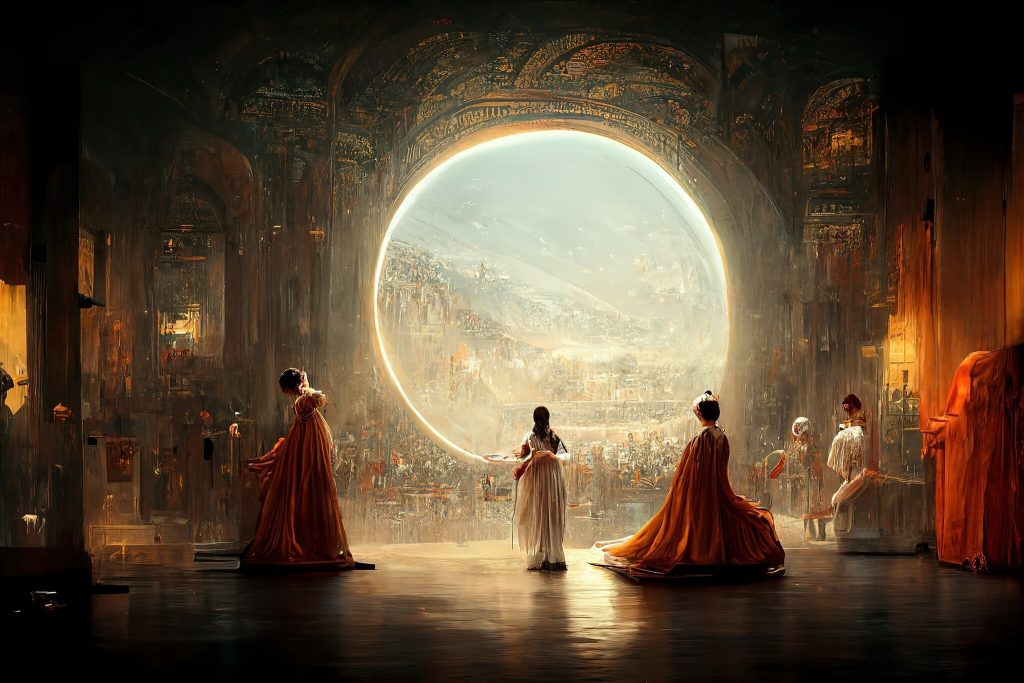
With the continuous advancement of computer technology and algorithms, the application of AI-generated content (AIGC) has gained widespread attention in recent years. For example, within just two months of its launch, ChatGPT reached 100 million monthly active users, and three months later, this number soared to an astonishing 1.8 billion. According to the International Data Corporation (IDC), global spending on artificial intelligence is expected to exceed US$300 billion between 2023 and 2026. AI technology has subtly transformed multiple industries, including automotive, finance, healthcare, retail, payments, art, smart homes, and more.[1] AI painting, as an important branch of AIGC, has increasingly entered the public eye in recent years. In August 2022, at the Colorado State Fair Art show held in Colorado, USA, an AI-generated work titled “Space Opera Theater” (Figure 1) won the prize in the Digital Art category, despite the contestant having no background in painting. This drew widespread attention. So, what is AI painting? What is its connection with traditional painting? What are the applications and impacts of AI painting? The following will provide a detailed introduction.
What is AI Painting
AIGC utilizes large training models and artificial intelligence technology to identify patterns from existing data and generate related content through generalization. AI painting applies AIGC to artistic creation, allowing users to generate corresponding paintings by simply inputting descriptive words (such as artist composition, style, colors, etc.), thus achieving cross-modal output from text to images and even videos. In recent years, several mainstream generative models, including Generative Adversarial Networks (GANs), Variational Autoencoders (VAEs), flow-based models, and diffusion models, have been primarily trained using deep learning. AI painting complements traditional painting, but due to the limitations of its creation mechanism, it lacks the vividness and humanized expressive style of traditional painting, leading to a lack of affinity and psychological resonance among the public.
There are many excellent AI painting platforms both domestically and internationally, such as Midjourney, Disco Diffusion, Stable Diffusion, and Baidu Wenxin. For example, “Space Opera Theater” was generated using Midjourney, a leading AI painting platform. Midjourney is an image generation application integrated into the Discord community, which has accumulated early data and an active community through differentiated product positioning. As of March 2023, the number of users on Discord exceeded 13 million, making it the server with the most users currently.

Figure 2 illustrates how Midjourney and Discord complement each other. Discord provides Midjourney with an excellent social experience platform and a vast user base, while Midjourney’s exceptional AI drawing capabilities drive community traffic to Discord. Furthermore, Discord’s community ecosystem helps Midjourney accumulate substantial data by encouraging users to rate the satisfaction of AI-generated images, aiding in the model’s continuous updates and optimization through discussions. Midjourney currently offers three subscription models, varying in response speed and image generation frequency. With the current user base, conservative estimates suggest that annual revenue could reach US$100 million. Figure 3 shows the rapid increase in Midjourney and Discord user numbers in recent years, reflecting the growing interest in AI art.

Impact of AI Art on Businesses (Taking Meitu as an Example)
The simplicity and low barrier to entry of AI art have attracted widespread attention from industry professionals and entertainment enthusiasts. Nearly half of AI art users are professionals in art design and the internet industry, who find it useful for design work and beneficial for sectors like gaming. Meitu is a successful example of how AI art can benefit businesses. Since 2008, Meitu has focused on portrait technology development through its “Meitu Xiuxiu” application, and began multi-dimensional exploration in 2013, though with limited success. After years of exploration, Meitu launched the Meitu Creative Platform in 2020 and introduced several AI products in 2023, such as Meitu Skin, Meitu Cloud Repair, and Meitu ID Photo. These products are monetized through subscription fees, single product payments, and API integration, successfully transitioning to a stable subscription-based business model and achieving significant profit growth. Figures 4 and 5 illustrate the steady increase in paying users and the notable rise in subscription revenue following the transition.


Not only has it significantly benefited the beauty industry, but there are also successful examples of AI art applications across various industries. For instance, AI has been used to create promotional materials in the advertising industry, such as the AI-generated poster for the 36th anniversary of Harper’s Bazaar; assist in generating comics and illustrations in the comics industry; and create visuals for the MV of Mohe Dance Hall in video production.
Limitations of AI Art
Dependence on Models: AI generation models heavily rely on training data and may not meet everyone’s requirements, and the results can be unpredictable.
Random Generation: The generator determines the composition when creating low-detail images, but this determination is random and it is difficult to specify the position of certain elements in the image.
Poor Precision: While Midjourney excels at drawing people, landscapes, and architecture, it struggles with abstract man-made objects like text shapes, IP characters, icons, and logos.
Difficulty in Fine-Tuning: Each image must be regenerated, and fine-tuning requires generating new images.
Technical Bottlenecks in AI-Generated Video
Currently, many applications support text-to-image generation, but text-to-video generation is less common and faces two significant technical bottlenecks:
Computational Control: Converting images to video involves generating at least 20 to 25 frames per second. Key concerns revolve around the manageability of computational resources for video generation and the potential for excessive rendering costs.
Image Control, Video Logic and Coherence: Generating 25 images per second means producing 1,500 images per minute. Important considerations include the controllability of image quality and the maintenance of logical consistency and coherence between images to meet the requirements for video.[2]
Future Opportunities and Challenges
The release of the Stable Diffusion graphic model by the open-source company Stability AI has greatly reduced development costs, providing AI art companies with a high-level and equitable technology platform. However, open-source models are not without limitations. High costs for hardware, operations, and training increase the industry’s entry barriers, and the uncertain return on investment is not something all companies can afford.
As AI art becomes more widespread and refined, it can help artists explore and create entirely new forms and styles, surpass traditional creative limitations, and open up new visual aesthetic fields. It can also provide personalized customization based on user preferences and needs, creating unique artistic works and experiences for individuals. AI art has the potential to become a powerful tool for art education, assisting people in learning and understanding artistic techniques and theories, lowering learning barriers, and making art education more accessible. Additionally, it can promote communication and collaboration across different cultures and art fields, driving global artistic diversity and richness.
However, AI art also brings issues such as copyright infringement and privacy concerns. The powerful learning and updating capabilities of AI have caused anxiety and fear among many industry professionals, as AI can master techniques in just a few days that might take years for human artists to develop, potentially threatening the employment of many entry-level artists. The artistic value of AI-generated works is also debated, with critics arguing that AI creations lack soul and that human intervention is necessary to produce satisfactory results. AI art also involves potential risks related to portrait rights and other infringements, with some artists expressing concerns about AI learning from their works without permission or requiring compensation and attribution.
NVIDIA founder and CEO Jensen Huang has commented on the future of AI art, saying “AI will provide artists with new ways of expression. This is not just automation but enhancing creativity in unprecedented ways.” It is believed that with the ongoing development of relevant laws and increased public participation and attention, the AI art industry will find a suitable and compliant path for growth.
Reference
[2] HorizonInsights.(2023). ‘科技與技術交匯,AI助美圖騰飛’
[3] GFSECURITIES.(2023).‘Midjourney: AI繪畫“小”模型的成功之道’
[4] XinluLiu2020J. Phys.:Conf. Ser. 1648032125
The work described in this article was supported by InnoHK initiative, The Government of the HKSAR, and Laboratory for AI-Powered Financial Technologies (AIFT).
(AIFT strives but cannot guarantee the accuracy and reliability of the content, and will not be responsible for any loss or damage caused by any inaccuracy or omission.)